


Four years after Turkey’s July 15, 2016 coup attempt, critics of Ankara’s official account continue to point to a series of logistical, military and political contradictions that they say have never been adequately investigated.
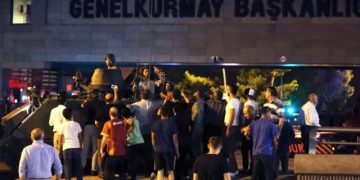
During previous military coups in Turkey, soldiers were deployed widely, including to remote towns and villages. On July 15, however, troops and tanks appeared only at a limited number of points in major cities. Critics ask whether this was because the goal was to create the appearance of a coup rather than to overthrow the government, or whether participation remained limited because then-Chief of General Staff Hulusi Akar and other senior commanders, who some defendants later suggested had given assurances before the deployments, did not follow through.
The same questions extend to political targets. In earlier coups, cabinet members and opposition leaders were detained from the first hours. On July 15, no attempt was made to detain Prime Minister Binali Yıldırım, main opposition Republican People’s Party leader Kemal Kılıçdaroğlu or Nationalist Movement Party leader Devlet Bahçeli.
Critics also ask why the Turkish Parliament was bombed instead of being taken over while lawmakers were inside. Was the aim to seize legislative power, as would be expected in a conventional coup, or to produce an image that would support the claim that a coup was underway?
The deployment to the Presidential Palace complex also remains a point of contention. The compound, guarded by thousands of police officers, was reportedly targeted by only 13 soldiers. Likewise, the small number of troops sent to the state broadcaster Turkish Radio and Television Corporation (TRT) and the state satellite operator TÜRKSAT were quickly overpowered.
Those facts raise another question: Did the commanders who planned the attempt make extraordinary tactical mistakes, or were the soldiers sent to those locations in numbers that made their capture almost inevitable?
There is no dispute that a faction within the Turkish Armed Forces attempted to seize power on July 15, leading to the deaths of 250 civilians and security personnel. But critics ask why Akar and other force commanders, who failed to prevent troops under their command from participating in unlawful actions, were not removed from office after the attempt failed.
President Recep Tayyip Erdoğan later defended Hakan Fidan, then head of the National Intelligence Organization, despite criticism that the intelligence agency failed to detect the coup preparations in time and did not properly inform the president or prime minister. “You do not change horses midstream,” Erdoğan said at the time.
Nearly a year after the coup attempt, critics were still asking why Fidan remained in office and why replacing him was not even being discussed. Had the “stream” still not been crossed, they asked, or were there other questionable “streams” still ahead?
The attack on the National Intelligence Organization’s headquarters in Ankara’s Yenimahalle district is another source of unanswered questions. A helicopter that attacked the compound reportedly fired only at the gates, injuring three protection officers.
If the alleged coup plotters intended to neutralize Turkey’s intelligence agency, why did they not target the main headquarters or the buildings where intelligence operations were conducted? Why were troops not dropped from the air to seize the facility? Why was such a critical target attacked by a single helicopter rather than by tanks, armored vehicles or a larger force?
Critics say the limited nature of the attack raises the possibility that the purpose was not to take control of the agency but to create the impression that “the intelligence agency was attacked.”
They also ask why statements given to the press that night claimed that the agency’s main headquarters had been targeted and even destroyed when the attack, according to this account, was limited to the gates.
Another disputed moment involves Nuh Yılmaz, then press and public relations adviser at the National Intelligence Organization. During a statement to the media on the night of the coup attempt, Yılmaz said “the coup has been brought under control” while gunfire from the attacking helicopter could be heard in the background.
Since Yılmaz was inside the intelligence compound at the time, critics ask how he could confidently say the attempt was under control while helicopter fire continued on the same premises. Residents in nearby buildings and staff housing blocks farther from the target reportedly feared in the dark that their buildings could be hit. Was it normal, critics ask, for Yılmaz, likely only 200 to 300 meters from the targeted gates, to appear so calm?
The alleged bombing of the Presidential Palace complex is also questioned. An aircraft said to have targeted the compound missed the large facility and instead hit a parked car outside the grounds. Was this a pilot error, critics ask, or was the purpose to cause limited damage that could support the narrative that “the Presidential Palace was bombed”?
Questions have also been raised about whether some public figures or media figures had advance knowledge of events that night. Images shared on social media appeared to show TRT anchor Tijen Karaş, who read the coup declaration on air, signaling to the control room as if to say she was ready just before the broadcast.
Doğu Perinçek, leader of the Homeland Party and a nationalist politician, mentioned the “Peace at Home Council,” the name later used by the coup plotters, in a video message published before the coup declaration was broadcast.
Aydın Doğan, then one of Turkey’s most influential media owners, later made a remark at an awards ceremony about journalist Hande Fırat, who conducted the FaceTime interview with Erdoğan that became one of the defining media moments of the night. Doğan said he had told Fırat, “Handle this business, and I will arrange your wedding.”
Critics ask whether the possibility that these figures had prior knowledge of the coup attempt was ever seriously investigated and whether their testimony was taken.
The questions surrounding Turkey’s 2016 coup attempt remain central to the dispute over the official account. For critics, the issue is not whether violence occurred or whether people were killed. It is whether the state’s version of how the night unfolded has ever been tested against the contradictions in the record.
The questions will continue.