

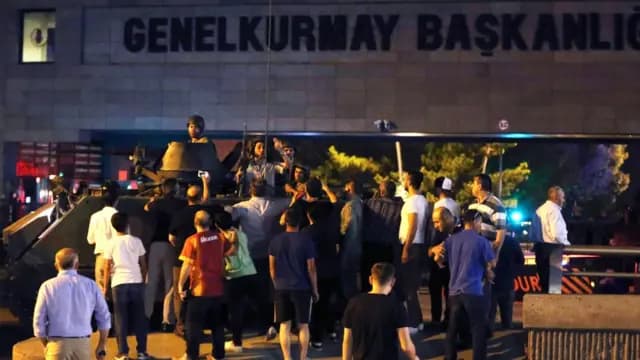
The defense of an Air Force officer who was on duty at Turkish General Staff headquarters in Ankara during the July 15, 2016 coup attempt raises a central question: how a soldier who says he helped evacuate a wounded commander by ambulance became linked to alleged actions at the headquarters after he had left the scene.
The officer, identified only by the initials K.Y., was serving at the General Staff Personnel Department on the night of July 15.
A defense transcript cited by Doğru Açı says K.Y. had been assigned to the department against his wishes and that the post was one of the ordinary places where an officer of his branch could serve, not evidence that he had been specially selected for an operation.
The defense says the case against him created a link between his assigned post and alleged events at General Staff headquarters without establishing where he actually was during the critical hours.
According to K.Y.’s account, soldiers outside the General Staff came under fire that night, and the commander of the Guard Battalion was wounded.
K.Y. said he did not move with any group during the chaos and stayed where he was until the gunfire eased.
He said that when the situation calmed, he saw the wounded battalion commander being placed on a stretcher and helped carry him to an ambulance.
“I went to the hospital by ambulance as an escort for the wounded Guard Battalion commander,” K.Y. said, according to the defense account cited by Doğru Açı.
The defense argues that from that point on, K.Y. was no longer at the General Staff but at the hospital, where he remained with the wounded officer.
It also says Ali Haberal, Mehmet Haberal and other military personnel at the hospital could have confirmed his presence and actions, but the court rejected requests to hear them as witnesses.
The defense says this created a time-and-place contradiction in the case: K.Y. was treated as if he had been involved in events at the headquarters even though his own account places him in an ambulance and then at a hospital.
Doğru Açı summarized the issue as a move “from ambulance to defendant’s chair,” saying the defense transcript sets out a chronology that separates K.Y.’s actual location from the allegations against him.
The key question raised by the defense is whether a soldier who helped carry a wounded commander to an ambulance and accompanied him to a hospital could later be linked to alleged acts at the General Staff without the court hearing witnesses who could confirm where he was.
The account adds to broader criticism of July 15 trials in which defendants have argued that courts treated assignment records, presence at military facilities or chain-of-command duties as evidence of involvement, while giving less weight to individual conduct and location during the night.