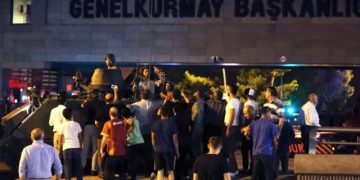



The head of Germany’s domestic intelligence agency said Ankara had failed to convince anyone outside Turkey that the Gülen movement was responsible for the failed coup attempt of July 15, 2016.
“I think no one outside Turkey believes that the Gülen movement was responsible for the attempted outside Turkey that the Gülen movement was responsible for the failed coup attempt of July 15, 2016,” Hans-Georg Maaßen, president of the Federal Office for the Protection of the Constitution (BfV), told the German news agency dpa.
“At least, I do not know anyone outside Turkey whom the Turkish government has convinced of this,” he added.
Maaßen made the remarks on the sidelines of the CeBIT technology fair in Hanover in March 2017.
He described cooperation between German and Turkish security authorities as “difficult, very difficult” and said Ankara had failed to provide evidence supporting its allegations against people accused of links to the movement.
President Recep Tayyip Erdoğan’s government blamed the movement inspired by Fethullah Gülen for the coup attempt and used the accusation to justify a purge of the military, judiciary, police, education system, media and public administration.
Gülen denied involvement and called for an international investigation.
Maaßen’s statement followed similar remarks by Bruno Kahl, the head of Germany’s foreign intelligence service, the Federal Intelligence Service (BND).
Kahl said Turkey had tried to convince German authorities at every level that Gülen directed the coup attempt but had failed to do so.
He described the Gülen movement as a civil association focused on religious and secular education rather than a terrorist organization.
TURKISH INTELLIGENCE LIST SPARKS SPYING INVESTIGATION
Maaßen’s comments came as German authorities investigated allegations that Turkey’s National Intelligence Organization (MİT) had conducted surveillance against government critics in Germany.
German media reported that MİT chief Hakan Fidan gave Kahl a list containing the names of more than 300 people and about 200 associations, schools and other institutions accused by Ankara of links to the Gülen movement.
The list reportedly included addresses, telephone numbers and photographs. German investigators suspected that some of the photographs had been taken through covert surveillance.
Instead of acting against the people named by Ankara, German authorities warned some of them that they might face arrest or retaliation if they traveled to Turkey.
German Interior Minister Thomas de Maizière said foreign intelligence operations on German soil would not be tolerated.
“Regardless of what you think of the Gülen movement, German law applies here, and citizens who live here will not be spied on by foreign states,” he said.
The Federal Prosecutor’s Office opened an investigation into suspected espionage activities.
Maaßen said intelligence agencies did not have friends but partners and that cooperation depended on personal trust.
His statement showed that while German agencies continued communicating with their Turkish counterparts on security matters, they rejected Ankara’s attempt to present its political accusations as established intelligence findings.