

Rear Adm. Mustafa Zeki Uğurlu, one of Turkey’s most senior officers serving at NATO in the United States during the July 15, 2016 coup attempt, has said the operation bore none of the features of a genuine military takeover and appeared designed to fail.
Speaking to former Turkish military officers on the Alesta YouTube channel, Uğurlu described the events as a trap and alleged that the Erdoğan government used staged or controlled violence to justify a purge of the Turkish Armed Forces.
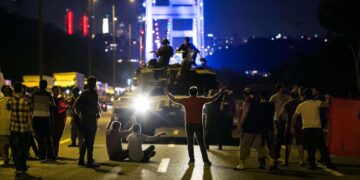
Uğurlu was serving at NATO’s Allied Command Transformation headquarters in Norfolk, Virginia, when he learned that soldiers had closed the Bosphorus Bridge and that a coup was reportedly underway.
He said the first reports did not make sense from a military perspective.
“If something like that had been planned, as the most senior Turkish military officer in the United States, they should have informed me first,” Uğurlu said.
He said he tried unsuccessfully to reach the chief of General Staff, the navy commander, fellow officers and his daughter in İstanbul.
Uğurlu argued that a real coup would have required coordinated action by army divisions, brigades, naval fleets, air squadrons and regional commands across Turkey.
Instead, he said, most military formations remained at their bases while limited and highly visible operations took place at several locations, including the Bosporus Bridge, parliament, Akıncı Air Base, the Special Forces Command and the hotel where President Recep Tayyip Erdoğan had been staying in Marmaris.
Uğurlu said the closure of a major bridge during prime time, the failure to detain political leaders, the continued operation of television networks and the bombing of parliament were actions that guaranteed public opposition and the failure of the operation.
“If you want a coup to fail, this is how you plan it,” he said.
He also questioned why experienced generals and admirals accused of organizing the coup would rely on small groups of soldiers and military cadets while leaving most of the armed forces inactive.
“These were officers who prepared the real operational plans of the Turkish Armed Forces,” Uğurlu said. “If they had wanted to stage a coup, they would not have planned any of what happened that night.”
Uğurlu described July 15 as a “diabolical plan” and compared the soldiers used in the operation to vessels sailing under a false flag.
He alleged that several bloody operations were carried out to create the public impression of a military coup and provide the government with grounds for the purge that followed.
The Turkish government accused Uğurlu of links to the Gülen movement and involvement in the coup attempt. He denied the allegations.
Although Uğurlu was in the United States on July 15, he was dismissed from the military by an emergency decree less than two weeks later.
He said he later discovered that his name appeared to have been added by hand to a military profiling list.
Uğurlu did not return to Turkey and sought asylum in the United States, saying he would not receive a fair trial.
His account challenges Ankara’s claim that July 15 was a coup planned and directed by the Gülen movement and instead portrays it as a controlled operation used to eliminate military officers and other government opponents.