


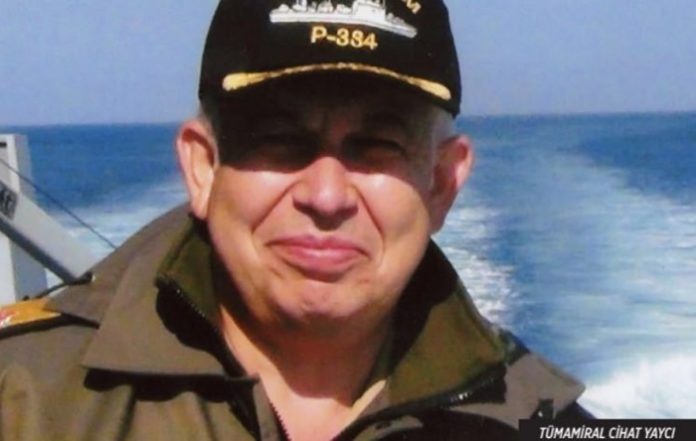
President Recep Tayyip Erdoğan has removed Rear Adm. Cihat Yaycı, the chief of staff of the Turkish Naval Forces Command, from his post and reassigned him to the General Staff, according to a presidential decision published in the Official Gazette.
The decision, signed by Erdoğan, said Yaycı had been appointed to the position listed next to his name under the presidential decree governing senior public appointments. Anadolu reported that the decree reassigned Yaycı from the Naval Forces Command to the General Staff.
The decree gave no reason for the move.
Yaycı’s reassignment drew attention not only because of his role in Turkey’s maritime policy but also because of his involvement in the post-coup purge inside the Turkish military.
He is widely associated with FETÖMETRE, a profiling and scoring system developed in the Naval Forces Command after Turkey’s July 15, 2016 coup attempt to identify personnel accused by Ankara of links to the Gülen movement.
Turkish Minute described FETÖMETRE as software developed by the Naval Forces Command and actively used since 2017, initially in the navy and later more broadly, to identify alleged followers of the movement.
Nordic Monitor has described the system more sharply, calling it an Excel-based algorithm designed by Yaycı to identify supposed members of the Gülen movement in the Turkish Armed Forces and one of the most controversial tools of post-coup mass persecution.
The Gülen movement, a transnational civic initiative inspired by Islamic scholar Fethullah Gülen, denies involvement in the coup attempt or any terrorist activity.
Critics say FETÖMETRE relied on broad indicators and guilt by association rather than individualized evidence, contributing to the dismissal and prosecution of military personnel accused of political or ideological links.
Yaycı was also known for his role in Turkey’s eastern Mediterranean policy and for promoting the “Blue Homeland” doctrine, an assertive maritime strategy that claims expansive Turkish rights in surrounding seas.
Turkish Minute has described the Blue Homeland doctrine as developed by former naval officers including Yaycı and Cem Gürdeniz, covering Turkey’s claimed maritime jurisdictions in the Black Sea, Aegean and Mediterranean.
Yaycı was also frequently described in Turkish media as one of the figures behind the maritime jurisdiction agreement Turkey signed with Libya’s Tripoli-based government in November 2019.
But the Libya agreement should not be treated as his entire profile.
Before his removal, Yaycı had become a symbol of two overlapping currents inside Erdoğan-era security policy: the post-coup purge of alleged Gülen-linked personnel from the armed forces and an increasingly nationalist maritime posture in the eastern Mediterranean.
The reassignment therefore raised questions about internal power struggles within the military and security establishment rather than merely about Turkey’s Libya policy.
Reports after the decision said Yaycı viewed the move as a demotion. He later resigned from the military, saying he had been removed from duty through “lies and slander,” according to reports citing his resignation letter.
For critics of the post-coup purge, Yaycı’s removal was notable because one of the officers most closely identified with the military’s profiling system had himself fallen out of favor.
No official explanation was issued for why Erdoğan removed Yaycı from one of the navy’s most senior posts and reassigned him to the General Staff.