

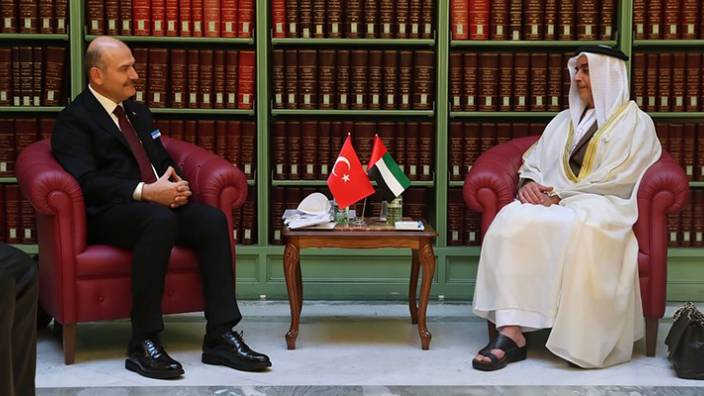
Turkey’s Interior Minister Süleyman Soylu met the United Arab Emirates’ deputy prime minister and interior minister, Saif bin Zayed Al Nahyan, in Rome five months after accusing the UAE, together with the United States, of being responsible for the 2016 attempted military takeover in Turkey.
Soylu was in Italy for the Parliamentary Assembly of the Mediterranean’s 2021 awards ceremony, where he received an award for KADES, a Turkish Interior Ministry emergency support app for women facing domestic violence.
Turkey’s Interior Ministry announced the Rome meeting on Twitter, saying Soylu had met “United Arab Emirates Deputy Prime Minister and Minister of Interior Lt. Gen. Saif bin Zayed Al Nahyan.” Independent Türkçe reported that the meeting took place during Soylu’s bilateral contacts in Rome.
The meeting drew attention because Soylu had publicly accused the UAE in May while responding on state-run TRT Haber to allegations made against him by Sedat Peker, an alleged organized crime leader who had been releasing videos and social media posts accusing senior Turkish officials of misconduct.
“The United Arab Emirates, together with the US, is the perpetrator of the July 15 coup,” Soylu said at the time, using the Turkish shorthand for the 2016 coup attempt.
“Those who accuse our president of anti-Semitism today are hiding the perpetrators of July 15 in the US, and their partners are in the United Arab Emirates,” he said. “Isn’t it obvious that these narratives are being ordered? They want to wear down the Turkish government with lies and slander.”
TRT Haber reported on May 19 that Soylu appeared on the channel to respond to Peker’s accusations, calling them part of an “international operation” against Turkey and saying he had personally ordered the operation against Peker’s organization.
Peker, once known for his pro-government stance, had turned against his former allies and made a series of allegations involving organized crime, politics and the state. In July he claimed Soylu had overseen the distribution of unregistered weapons to civilians during and after the 2016 coup attempt, an allegation Soylu rejected.
Soylu’s Rome meeting also came as Ankara and Abu Dhabi were moving toward a public thaw after years of regional rivalry.
In August, President Recep Tayyip Erdoğan received UAE National Security Adviser Tahnoun bin Zayed Al Nahyan in Ankara, with both sides discussing economic cooperation, trade and investment opportunities.
Independent Türkçe also reported that Abu Dhabi Crown Prince Mohammed bin Zayed Al Nahyan was expected to visit Turkey in the coming days for talks with Erdoğan.
That diplomatic context makes Soylu’s meeting politically significant: A senior Turkish minister who had accused the UAE of involvement in the country’s most consequential security crisis was now publicly meeting his Emirati counterpart without any announced clarification, evidence or retraction of the earlier allegation.
The episode highlights a broader pattern in Ankara’s post-coup rhetoric, in which foreign governments have at times been accused of involvement in the attempted takeover, while diplomatic and economic needs later pushed Turkey back toward engagement with the same states.