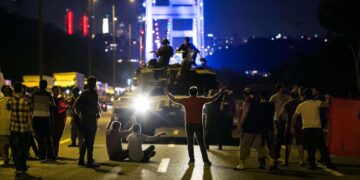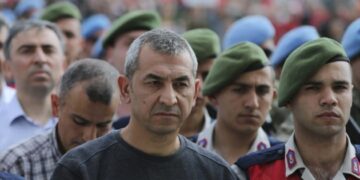


Yeniçağ columnist Arslan Bulut has questioned whether Turkey’s July 15, 2016 coup attempt was used to prepare the ground for an authoritarian presidential system, comparing the political aftermath of the failed putsch to historical examples in which crises were used to dismantle parliamentary democracy.
The debate came as the ruling Justice and Development Party (AKP) was pushing constitutional changes that would replace Turkey’s parliamentary system with an executive presidency. Critics said the proposal would strip parliament of meaningful power and remove checks on President Recep Tayyip Erdoğan.
Bulut said his previous column, titled “Was the coup allowed to happen to clear the path for a presidential system?” examined remarks by opposition lawmaker Aytun Çıray and Selin Sayek Böke, then a spokesperson for the main opposition Republican People’s Party (CHP).
Çıray had said, “We must be ready to evaluate the allegations that the coup was carried out within the framework of a script.” Böke had asked, “Did the government have prior knowledge of Turkey’s 2016 coup attempt?”
Bulut also cited journalist Saygı Öztürk, who wrote that a lawyer in an important case had asked him by phone, “Do you know where Major General Mehmet Dişli, the brother of Justice and Development Party lawmaker Şaban Dişli, is?”
Öztürk said he replied that Dişli was probably in Sincan Prison but came away with the impression that the lawyer knew something different and that Dişli might not be in prison.
Bulut said such suspicions make it necessary to ask what the real purpose of the coup attempt was.
Questions over whether the coup attempt enabled a new regime
Bulut wrote that, based on its consequences, some critics question whether the coup attempt laid the groundwork for what they describe as an “elected dictatorship system” under the name of a presidential system.
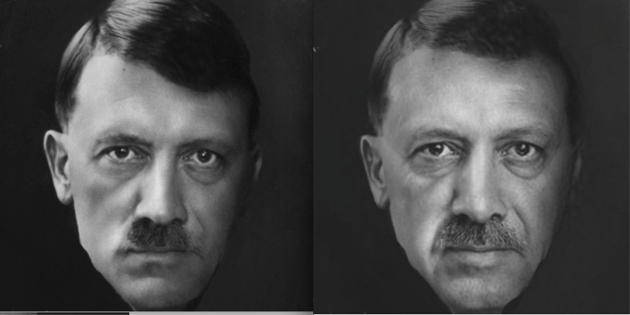
He then cited political commentator Haluk Dural, who drew a chronology comparing the aftermath of the coup attempt in Turkey with Adolf Hitler’s rise to absolute power in Germany after the Reichstag fire.
Dural noted that Hitler, leader of the National Socialist German Workers’ Party, became chancellor on January 28, 1933. On February 27, 1933, the Reichstag, the German parliament, was set on fire.
In Dural’s comparison, the Reichstag fire is placed next to the bombing of the Turkish Parliament during the 2016 coup attempt. Ankara says the coup attempt was organized by military officers affiliated with the Gülen movement, a transnational civic initiative inspired by Islamic scholar Fethullah Gülen. The movement denies involvement.
Dural said that on March 23, 1933, the Enabling Act transferred the German parliament’s powers to the cabinet and therefore to Hitler for four years, suspending parliamentary authority in practice.
Bulut wrote that, in Turkey, the post-coup state of emergency similarly concentrated legislative and executive power in the Council of Ministers and the president through emergency decrees.
Dural also compared Hitler’s assumption of presidential powers after President Paul von Hindenburg’s death on August 2, 1934, with the constitutional changes proposed by the AKP. Hitler’s combined role as president and chancellor was later approved in a referendum with 89.93 percent “yes” votes.
Bulut said the AKP’s constitutional proposal served the same purpose by consolidating executive authority in one office.
Under the German system that followed, Hitler gained the power to appoint and dismiss civil servants, became commander-in-chief of the armed forces and acquired the power to use the military and declare war. Bulut described this as the legal foundation for “the greatest catastrophe humanity has ever faced.”
CHP lawmaker compares AKP proposal to Syria’s constitution
Bulut also cited Cemal Okan Yüksel, a CHP lawmaker from Eskişehir, who said from the parliamentary rostrum that the AKP’s constitutional draft resembled the constitution of Syrian President Bashar al-Assad’s regime.
Yüksel compared several articles in the AKP proposal with provisions in the Syrian constitution.
Article 93 of the Syrian constitution says the president exercises executive authority within the limits recognized by the constitution. The AKP proposal said executive power would be exercised by the president.
Article 95 of the Syrian constitution says the president chooses vice presidents, delegates some duties to them, appoints ministers, accepts their resignations and removes them from office. Article 104 in the AKP proposal said the president would appoint and dismiss vice presidents and ministers.
Article 107 of the Syrian constitution allows the president to dissolve the People’s Assembly. Article 116 in the AKP proposal allowed the president to dissolve the Turkish Parliament.
Article 139 of the Syrian constitution gives the president authority to appoint members of the Constitutional Court. Article 146 in the AKP proposal allowed the president to appoint 12 of the 15 members of Turkey’s Constitutional Court, while parliament would appoint the remaining three.
Yüksel also compared budget provisions. Under Articles 74 and 77 of the Syrian constitution, if parliament does not approve the budget before the start of the fiscal year, the previous year’s budget remains in force until a new one is approved. Under Article 116 in the AKP proposal, if parliament did not approve the budget, the previous year’s budget would be increased and continue to be implemented.
Bulut says public confusion must be addressed
Bulut said the central question must be answered openly: Was Turkey’s 2016 coup attempt an operation that cleared the way for an Assad- or Hitler-style regime in Turkey?
He argued that public confusion over the coup attempt and its political aftermath cannot be resolved unless the government’s narrative, the conduct of state officials and the constitutional changes that followed are examined together.
For Bulut, the issue is not only what happened on the night of July 15, but how the failed coup was later used to restructure the Turkish state. The comparison to the Reichstag fire, he suggested, reflects a deeper fear among critics that a national trauma became the pretext for dismantling parliamentary democracy.