

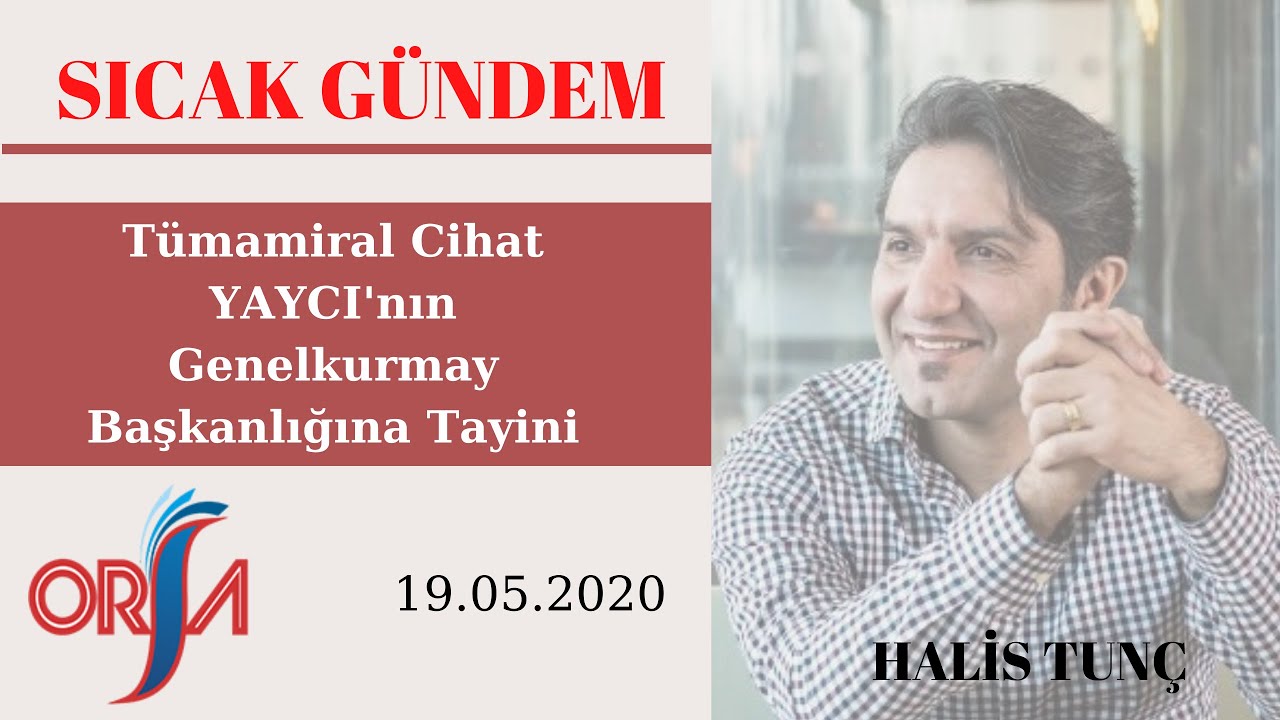
Former Navy Staff Col. Halis Tunç says the reassignment and resignation of Rear Adm. Cihat Yaycı, a central figure in Turkey’s post-2016 military purge, exposed a power struggle between President Recep Tayyip Erdoğan’s camp and nationalist-secularist networks seeking influence over the future shape of the Turkish Armed Forces.
“He was offended because he had to go 30 or 100 meters,” Tunç said in substance, asking why the honor and dignity of officers recalled from abroad under far harsher conditions had not mattered.
Two camps fought over Yaycı, Tunç says
Tunç said the public campaign around Yaycı’s transfer showed that two groups were clashing: one seeking to remove him and another trying to protect him.
He pointed to earlier comments by pro-government politician Mehmet Metiner and later public interventions by nationalist-secularist and pro-Ergenekon figures who launched what Tunç called a “Cihat Yaycı rescue operation” after the transfer decree became public.
According to Tunç, writers and public figures including Ahmet Zeki Üçok, Nedim Şener, Ardan Zentürk, Mehmet Metiner, Özgür Özel, Cem Gürdeniz, İsmail Hakkı Pekin, Semih Çetin, Yaşar Hacısalihoğlu, Ali Türkşen, Güven Şaban and Ceyhun Bozkurt were among those who defended Yaycı or criticized the move.
Tunç said this broad reaction made clear that Yaycı had become more than a bureaucratic figure. He described him as an instrument in a larger struggle over who would shape the Turkish Armed Forces after mass purges had emptied much of its senior professional cadre.
Official reason and political framing
Tunç said commentators such as Ahmet Zeki Üçok and Saygı Öztürk had written that Yaycı’s transfer was linked to an investigation involving a tender related to torpedo guidance systems, an allegation that had reportedly been pending for months.
He said this explanation might account for the formal reason behind the transfer. But he argued that some writers placed the actual reason in the middle of long columns while framing the issue publicly as if Yaycı had been removed because exiled military accounts had targeted him over FETÖMETRE, the controversial profiling system used in the Turkish military after the coup attempt.
Tunç rejected that framing as manipulation. He said the public was being misled by people who knew the underlying power struggle but preferred to present the issue as the result of criticism by dismissed officers abroad.
FETÖMETRE refers to a set of profiling criteria used after the coup attempt to identify people accused by the state of links to the Gülen movement, a transnational civic initiative inspired by Islamic scholar Fethullah Gülen. Ankara designates the movement as a terrorist organization and blames it for the coup attempt. The movement denies involvement.
FETÖMETRE as a ‘postmodern genocide tool’
Tunç said his criticism of Yaycı was not personal but tied to the human rights consequences of the profiling system. He described FETÖMETRE as a “postmodern genocide” tool and said it had led to enormous violations of basic rights.
He said he first learned the details of the system through the writings of Nedim Şener and through accounts shared by a noncommissioned officer who had served in the branch that implemented it, later identified in ORSA TV programs as the Judicial Monitoring, Administrative Procedure and Review Branch, known by its Turkish initials as ATİİİ.
Tunç said the system affected not only military personnel but also civilians and other state institutions, creating a much wider circle of harm. Citing figures attributed to Nedim Şener, he said investigations, detentions and dismissals had directly affected hundreds of thousands of people and indirectly affected millions of family members.
“This is a massive human rights violation,” Tunç said in substance, arguing that silence on such a scale of abuse could not be expected.
He said the purge of the Turkish Armed Forces had followed a plan signaled shortly after the coup attempt by then-Prime Minister Binali Yıldırım, who said large shares of staff officers, regular officers and cadets were linked to terrorism. Tunç argued that the numbers cited then overlapped with the actual dismissals over the following years.
According to Tunç, about 55,000 members of the military, including cadets, had already been purged, and another 20,000 were expected to be removed as new personnel were recruited. He said the total would reach about 75,000 people, including many highly trained officers, staff officers, technical personnel and noncommissioned officers.
Who would shape the new military?
Tunç argued that the purges had emptied the Turkish Armed Forces of much of its old professional structure, creating a new struggle over who would fill the vacuum.
He said the question was whether Erdoğan or nationalist-secularist and pro-Ergenekon networks would shape the new military and other state institutions, including the Foreign Ministry and the judiciary.
Yaycı, in Tunç’s account, stood at the center of that struggle. He said Yaycı had fulfilled his function during the purge process but became vulnerable once the next stage of institutional reshaping began.
“Cihat Yaycı was only an instrument,” Tunç argued, saying the purge would have proceeded even without him because the broader plan was already in motion.
Yaycı’s relationship with Erdoğan and nationalist circles
Tunç traced Yaycı’s career through the years before and after the coup attempt, saying he was promoted to rear admiral in 2012 during the Ergenekon and Sledgehammer trial period and later given prestigious assignments, including as military attaché in Moscow and commander of a key naval task group.
He noted that Yaycı’s name had appeared in Aydınlık newspaper and alleged intelligence reports in 2014 in connection with Gülenist claims, yet he was still appointed to important positions by the Naval Forces Command.
Tunç emphasized that he did not believe Yaycı was affiliated with the Gülen movement. He said no Turkish officer could legitimately be connected to any religious community, political party or organization, and that such claims were often instrumentalized.
But he said it was striking that figures who had once accused Yaycı later moved to protect him, suggesting a shared interest.
Tunç also drew attention to July 9, 2016, when Erdoğan’s public schedule became unclear before the coup attempt. He said Yaycı also went on leave around the same time and stayed in Marmaris, where Erdoğan was staying. Tunç presented this as one of several coincidences requiring scrutiny.
He said nationalist officers often described Yaycı as “the only general who could visit the president without permission,” suggesting unusually direct access to Erdoğan.
Eastern Mediterranean policy and the Libya deal
The program also examined claims that Yaycı’s departure would damage Turkey’s Eastern Mediterranean, Aegean and Libya policies.
Tunç rejected the idea that one rear admiral could determine such policies alone. He said the Turkish state had been working on maritime boundary issues with Egypt and Libya since at least 2003, following Greek Cyprus’s maritime delimitation agreement with Egypt.
He said those policies were not invented by Yaycı, even if Yaycı later became publicly associated with them.
Tunç also questioned Yaycı’s claim that Turkey and Israel could have a maritime boundary agreement, saying then-Foreign Ministry official Çağatay Erciyes had argued there was no Turkish-Israeli exclusive economic zone boundary. Tunç said he agreed with Erciyes on that point.
On the Aegean, Tunç said claims about demilitarized Greek islands and Turkish rights over them were highly sensitive and could create serious tensions with Greece, the North Atlantic Treaty Organization and the United Nations.
He said Yaycı’s May 2020 notice to mariners involving exercises around demilitarized islands had likely caused alarm in Greece and could have contributed to concerns inside the Turkish government that nationalist-secularist networks were steering the country toward a crisis.
Possible coup and assassination claims
Tunç said allegations had circulated that nationalist-secularist or pro-Ergenekon groups were planning a coup or assassinations. He said he did not find a direct military coup likely because, in his view, such groups would struggle to find people to carry it out.
But he said assassinations, social unrest or a foreign-policy crisis could create an environment in which military mobilization became possible. He linked this to earlier coup-planning traditions in Turkey, arguing that crises with Greece had historically been viewed as useful triggers for military intervention scenarios.
Tunç said this possibility may have been one reason Erdoğan’s side moved against Yaycı.
‘A human rights cutting machine’
Tunç concluded by returning to FETÖMETRE, saying Yaycı’s resignation would not cause him to stop discussing the system.
He described FETÖMETRE as “the greatest unlawful practice world history has seen” and said it violated fundamental human rights, the Turkish Constitution and existing laws.
He argued that those responsible for creating and applying it would eventually have to answer before the law, including before international legal bodies.
Tunç said Yaycı had served as a tool that Erdoğan and nationalist-secularist actors could use without directly dirtying their own hands. But, he argued, once the purge phase ended and the struggle over institutional control began, Yaycı’s usefulness changed.
The video below presents Tunç’s full discussion of Yaycı’s transfer and resignation, the FETÖMETRE system, the Eastern Mediterranean debate and the power struggle over Turkey’s post-coup military order.