

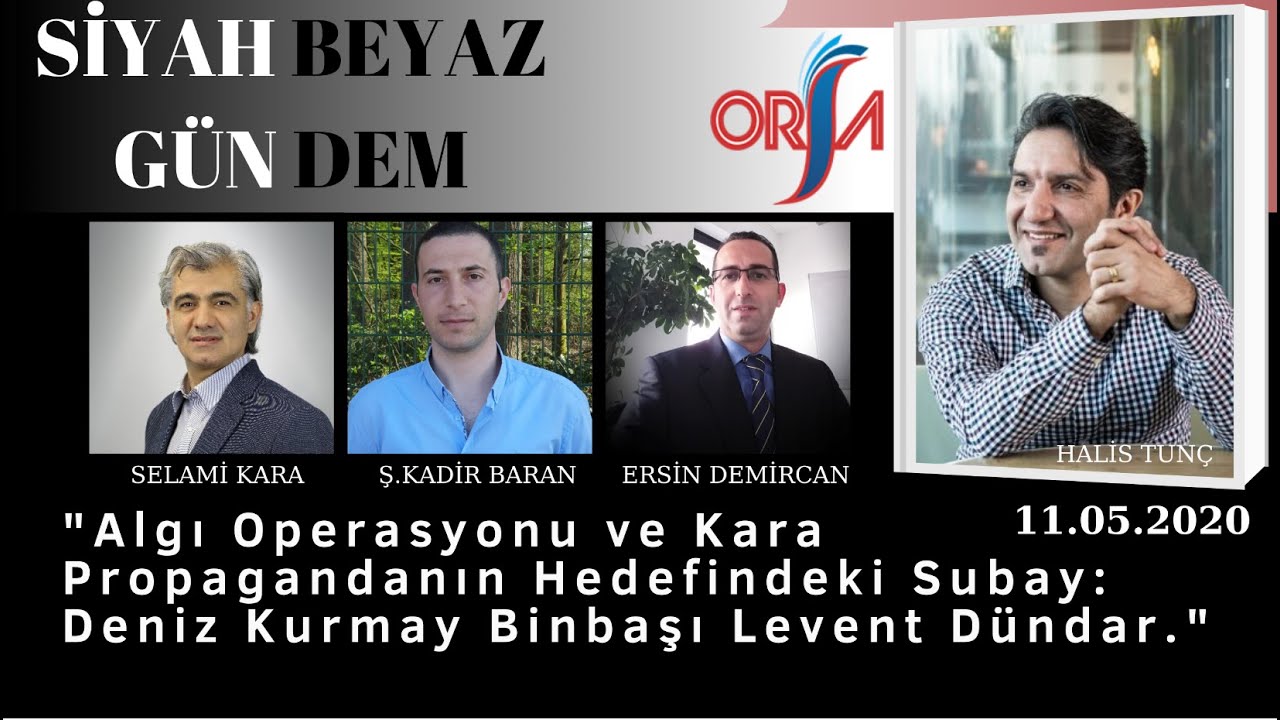
An ORSA TV program broadcast on May 11, 2020, examined the case of Navy Staff Maj. Levent Dündar, arguing that he was targeted by a coordinated perception operation and black propaganda campaign to legitimize a controversial profiling system used in Turkey’s post-2016 military purge.
Ankara designates the movement as a terrorist organization and blames it for the coup attempt. The movement denies involvement.
Child’s death cited as example of collective punishment
The program opened with the death of Ahmet Ataç, an 8-year-old cancer patient whose family had struggled to secure travel documents for treatment abroad because his father was imprisoned. Tunç said Ataç’s case illustrated how post-coup measures affected not only accused individuals but also their relatives.
According to the program, the child’s illness had been widely discussed on social media for nearly a year. His family eventually obtained permission to travel to Germany, but by then, Tunç said, the cancer had spread too far.
Tunç linked the case to the broader logic of FETÖMETRE, saying that under similar profiling criteria, relatives and extended family members could be stigmatized by association.
Program cites figures on military dismissals
The episode also discussed a March 13, 2020 statement by Turkey’s Ministry of National Defense, which said 19,075 members of the Turkish Armed Forces had been dismissed and judicial or administrative proceedings were continuing against 5,183 others.
Tunç said those figures did not include the gendarmerie, the coast guard, contract officers, noncommissioned officers, specialists and military cadets. When those groups were included, he said, the total number of people purged from Turkey’s military structure reached about 55,000.
The program argued that those dismissals were not the result of a neutral legal process but of lists, profiling and administrative mechanisms later presented to the public as an effective counterterrorism tool.
Why FETÖMETRE was created
Tunç said FETÖMETRE was created because the authorities needed a framework to retroactively justify purges that had already been planned. He recalled that then-Prime Minister Binali Yıldırım said shortly after the coup attempt that nearly all staff officers, large numbers of officers and most cadets in the Turkish Armed Forces were linked to terrorism.
The program argued that later dismissals largely matched those early political claims and that the profiling system was used to give them an appearance of method and legality.
Demircan, who said he had worked in the branch where such procedures were applied, described the initial target group as well-trained, successful and professionally qualified personnel in the Turkish Armed Forces who were seen as resistant to anti-democratic practices.
The discussion identified the relevant branch as the Judicial Monitoring, Administrative Procedure and Review Branch, known by its Turkish initials as ATİİİ.
Barış Dedebağ case raised in discussion of alleged evidence production
Baran discussed the case of Maj. Barış Dedebağ, who was portrayed in pro-government media as a hero who resisted the coup attempt at the Armored Units Command in Ankara.
Baran said Dedebağ later left the military and was appointed to an advisory role connected to the Prime Ministry. He alleged that Dedebağ played a role in efforts to produce testimony against defendants in post-coup trials.
According to Baran, one noncommissioned officer said he was offered a management position in a military factory in exchange for making statements against Lt. Gen. Metin İyidil, and said the offer came from Dedebağ. Baran said other personnel had made similar claims involving public-sector positions and that WhatsApp messages were used to support at least part of the allegation.
Baran said he did not view the case as isolated. He argued that some public officials appeared to have been tasked with producing or encouraging testimony against defendants after the coup attempt, although he acknowledged that he did not have direct documentary proof of a centralized order.
Program challenges claim that FETÖMETRE applied only to existing judicial suspects
The participants also challenged journalist Nedim Şener’s claim that FETÖMETRE was applied only to people already involved in judicial processes.
Demircan said that was not accurate, arguing that the process itself often produced the judicial or administrative action. He said scores assigned under the system could lead to different outcomes, including no action, review, temporary suspension, dismissal from public service, deprivation of public rights or criminal complaints.
The program said this showed that FETÖMETRE was not merely an auxiliary tool used after legal suspicion had already emerged, but a mechanism that could itself trigger action against individuals.
Levent Dündar case presented as propaganda example
The second half of the program focused on Navy Staff Maj. Levent Dündar, who was presented in Turkish media in September 2018 as an officer allegedly exposed by FETÖMETRE.
According to the program, media reports claimed Dündar had entered naval high school without taking the entrance exam, sports test or medical screening. They also claimed his name appeared on the admissions list by coincidence because of a name similarity, that his wife and brother were suspects in Gülen-linked investigations, that he had used the encrypted messaging application ByLock, that he had actively participated in the coup attempt and that foreign-language exam questions had been given to him in advance.
The program said those allegations were carried for days by pro-government media as well as outlets presenting themselves as opposition, nationalist or secularist, creating a broad media consensus around what the participants described as a fabricated story.
Kara said the claim that Dündar entered the school without taking the exam was false. According to Kara, Dündar had passed the naval high school exam, but another student’s name was mistakenly written opposite his candidate number in the published list. He said a telegram signed by an English teacher serving on the exam commission confirmed that Dündar had passed.
Kara said Dündar later completed the required sports, health and interview procedures before enrolling, adding that it would have been impossible to place a student into a military school secretly without passing through multiple commissions and leaving records in the student’s file.
Tunç said such documents, including health reports and test records, would have remained in the student’s personal file and been reviewed repeatedly during inspections by the school command, training command and Naval Forces Command.
The program described the allegation as absurd, arguing that if an organization supposedly had the ability to provide exam questions or manipulate mass admissions, it made no sense to claim it had inserted one student through such a crude clerical irregularity.
Program says media campaign helped sell purge system
The participants argued that Dündar’s case was used to market FETÖMETRE to the public as a precise and effective system, even though the underlying claims were, in their view, misleading or false.
They said the public presentation of the case made it appear as though FETÖMETRE had uncovered a hidden infiltration story, while the actual issue was a decades-old clerical mistake involving a candidate number and name on an admissions list.
The program said the case showed how media narratives, administrative mechanisms and legal processes worked together during Turkey’s post-coup purge.
It concluded that Dündar’s case would be examined further in a follow-up episode, with additional claims from the media reports to be addressed one by one.
The video below presents the full discussion on Ahmet Ataç, military dismissals, FETÖMETRE, Barış Dedebağ, Nedim Şener’s claims and the allegations targeting Navy Staff Maj. Levent Dündar.