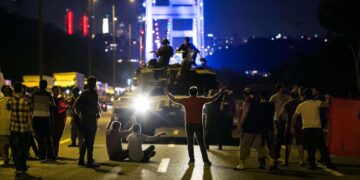



Turkey dismissed thousands more public employees under a new emergency decree published in July 2017, expanding the mass purge launched after the July 15, 2016 coup attempt.
The decree removed personnel from the police, judiciary, foreign ministry, education system, health ministry, religious authority, armed forces and Interior Ministry without ordinary disciplinary proceedings.
The largest number of dismissals was from the General Directorate of Security, where 2,303 police personnel were removed.
The decree also dismissed 1,486 personnel from the Interior Ministry, 789 from the Ministry of Health, 551 from the Directorate of Religious Affairs, known as Diyanet, and 546 from the Land, Naval and Air Forces.
Another 418 personnel were dismissed from the Ministry of Justice, 302 academics from the Council of Higher Education, or YÖK, 102 personnel from the Ministry of National Education and 45 from the Ministry of Foreign Affairs.
The decree also included a small number of reinstatements, but the overall effect was another large-scale purge of state institutions under Turkey’s state of emergency.
Medals previously awarded to former national football players Hakan Şükür and Arif Erdem were revoked.
The decree also stripped the military ranks of 342 retired Turkish Armed Forces personnel.
Emergency decrees, known in Turkey as KHKs, became one of the main tools of the post-coup purge, allowing the government to dismiss public servants, close institutions, seize assets and impose penalties without the ordinary legislative or judicial process.
Many of those dismissed were accused of links to the Gülen movement, a transnational civic initiative inspired by Islamic scholar Fethullah Gülen.
Ankara blames the coup attempt on the movement and designates it as a terrorist organization. The movement denies involvement in the coup or any terrorist activity.
Rights advocates and purge victims said the decree system imposed collective punishment by removing people from public service and attaching lasting civil consequences to administrative lists, often without individualized evidence or an effective appeal mechanism.