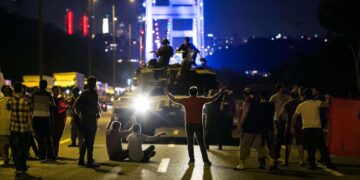

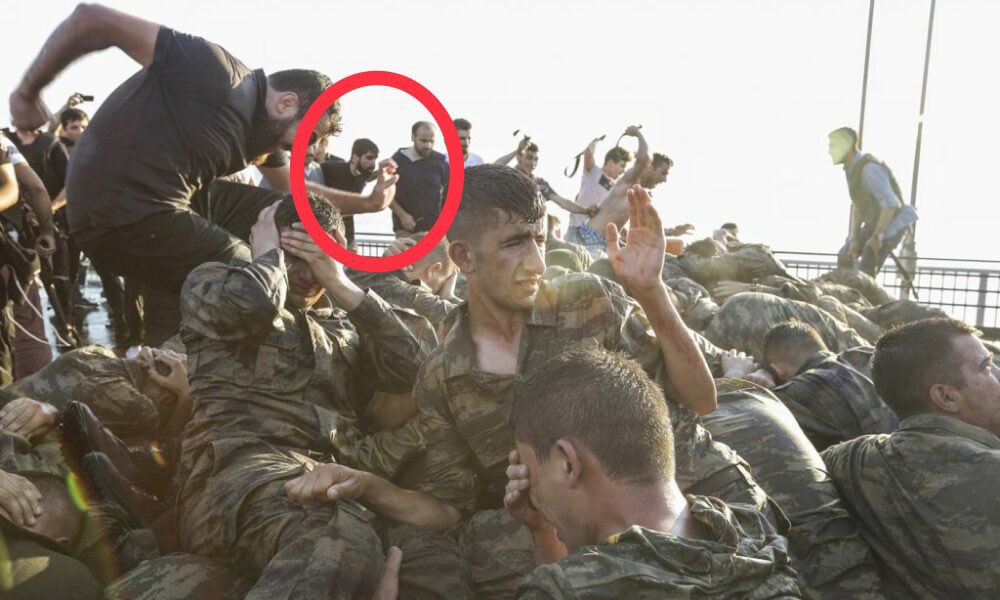
Journalist Erk Acarer has alleged that Mehmet Fatih Demirci, an official at the Turkey Youth Foundation, or TÜGVA, was among the crowd that attacked soldiers on the Bosporus Bridge in İstanbul during Turkey’s July 15, 2016 coup attempt.
Demirci serves as organizational head of TÜGVA’s headquarters university coordination unit, according to reports on his statement. TÜGVA is a pro-government youth foundation whose advisory board includes President Recep Tayyip Erdoğan’s son Bilal Erdoğan.
Acarer said Demirci was in the group involved in the killing of two military cadets and a private on the bridge.
The soldiers killed on the bridge have become one of the most disputed parts of the July 15 record, with families and rights advocates saying attacks on surrendered cadets were not properly investigated.
Turkish Minute previously reported that an autopsy report on cadet Ragıp Enes Katran showed severe injuries, while the Stockholm Center for Freedom reported that the family of cadet Murat Tekin, who was killed on the bridge, was later ordered to pay compensation to the state over alleged public property damage.
Demirci, responding to Acarer’s allegation, confirmed that he was among the crowd on the bridge but denied involvement in the killings.
He said he did not slit the throats of cadets or crush a private’s head with a stone, and claimed that he only slapped a ranking soldier.
“A situation as claimed by some people never happened,” Demirci said.
Photographs from the night of July 15 appear to show Demirci in the crowd during the attacks on soldiers, according to the reports.
Acarer responded to Demirci’s explanation by saying, “For some reason, ‘just a single slap’ did not sound very plausible to me. Feel free to make another statement if you wish.”
The allegation is politically sensitive because TÜGVA has recently faced broader scrutiny over leaked documents claiming that its members were placed in state institutions through favoritism, including the military, police and judiciary.
The bridge violence also remains a major unresolved issue in the public debate over July 15.
While the government’s official narrative focuses heavily on civilians killed while resisting the coup attempt, critics say the killings and beatings of surrendered soldiers and cadets have received far less judicial and political attention.
Acarer’s claim does not by itself establish Demirci’s criminal responsibility.
But Demirci’s acknowledgment that he was present in the crowd adds to calls for a fuller investigation into who attacked soldiers on the bridge, how the violence unfolded and why those responsible were not publicly identified and tried.