

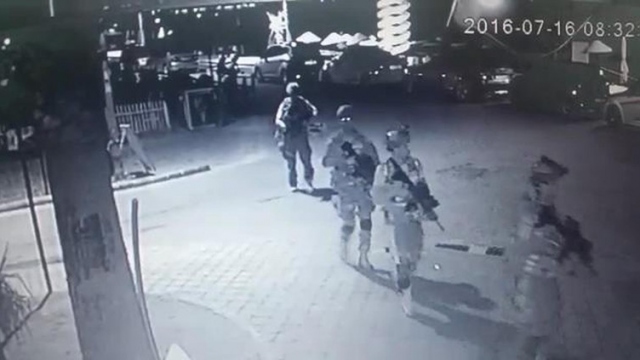
Flight and communications records that could identify three helicopters seen near President Recep Tayyip Erdoğan’s hotel in Marmaris hours before the soldiers later convicted of attempting to assassinate him arrived were removed from official archives, according to journalist Adem Yavuz Arslan.
Arslan reconstructed the events in Marmaris from July 9 through the early hours of July 16, 2016, arguing that the timeline exposes an armed operation excluded from Ankara’s account of the coup attempt.
The government says a team commanded by Brig. Gen. Gökhan Şahin Sönmezateş flew from Çiğli Air Base near İzmir to capture or kill Erdoğan at the hotel where he was vacationing.
That team did not reach Marmaris until around 3:38 a.m.
Erdoğan had already left the hotel hours earlier and had arrived in İstanbul under the official timeline.
Yet witnesses reported helicopters, armed men and gunfire near the hotel from around 1 a.m., while Sönmezateş and his soldiers were still waiting at Çiğli.
Journalist Merdan Yanardağ later brought the alleged second team to public attention on Tele1. Arslan said witness statements, court documents and media footage had already pointed to the same conclusion.
Another armed group reached the hotel before the soldiers prosecuted in the Marmaris case.
THREE HELICOPTERS BEFORE THE ACCUSED TEAM
Arslan said three helicopters appeared over the hotel area about two hours before Sönmezateş’s team arrived.
Witnesses included police officers, medical personnel, hotel guests, local residents and tourists.
They described armed people dressed in black, gunfire directed at the hotel and clashes that began before the arrival time established for the accused soldiers.
Two police officers, Mehmet Çetin and Nedip Cengiz Eker, were killed during the events in Marmaris.
The deaths were attributed to the soldiers in the Sönmezateş team, although Arslan argues that the chronology and forensic evidence did not establish which armed group fired the fatal shots.
When Sönmezateş and his personnel finally reached the hotel, they encountered signs that an armed confrontation had already taken place.
They also had difficulty finding the hotel and stopped a taxi driver to ask for directions, weakening the claim that they had conducted a prepared assassination operation against a known location.
RECORDS OF EARLIER HELICOPTERS DISAPPEARED
Military flights generate radar records, air traffic communications, radio conversations, mission logs and records at command centers.
Those records should have revealed where the three earlier helicopters took off, their routes, their call signs, their crews and the commands they received.
Arslan said none of those records was produced in court.
The radar tracks disappeared.
The radio communications disappeared.
The flight and mission logs disappeared.
The records should have existed within both the Air Force and General Staff systems, meaning their removal required access at the highest levels of the military command structure.
Arslan asked which authority had the power to erase the same operation from several military archives and why prosecutors did not investigate the missing records.
SÖNMEZATEŞ’S REQUESTS IGNORED
Sönmezateş asked the court to obtain telephone signal records for Akıncı Air Base and Marmaris between 5 p.m. and 6 a.m.
He also requested the flight records of helicopters operating over Marmaris while his team was still waiting in Çiğli.
Those records could have established whether another team reached the hotel before his soldiers.
The court did not obtain the material.
Instead, the prosecution treated the arrival of Sönmezateş’s team as the beginning of the armed operation in Marmaris and attributed the earlier violence to the same group.
Arslan argues that this collapsed two separate timelines into one and protected the identity of the personnel who arrived first.
PREPARATIONS BEGAN BEFORE JULY 15
Arslan’s chronology also identifies security and aviation arrangements made before the coup attempt.
He said cameras covering the area where Erdoğan’s presidential aircraft would park at Dalaman Airport stopped working on July 6.
Senior military commanders visited or inspected the Marmaris area before Erdoğan arrived.
Aircraft were positioned at different airports, police reinforcements were sent to the region and senior Air Force officer Lt. Gen. Yılmaz Özkaya was present near Dalaman rather than at a wedding attended by much of the Air Force command.
Özkaya later became involved in operations concerning the helicopters used by Sönmezateş’s team and sought authorization for fighter jets to intercept them.
He subsequently participated in the military investigation of the same events.
Arslan argues that these preparations show Marmaris was not an improvised response to an unexpected coup attempt but the site of an operation arranged in advance.
WHO SENT THE FIRST TEAM?
The official case answered who arrived in Marmaris after 3 a.m. but did not answer who arrived around 1 a.m.
It did not identify the earlier helicopters, their pilots, their passengers or the command that deployed them.
It did not explain why their records vanished or why the court refused requests that could have reconstructed their movements.
The erased records leave the central question of the Marmaris operation unanswered:
Who sent the first armed team to Erdoğan’s hotel, and why was every trace of its flight removed?